


Rise and fall of the dynasty at Audley End
Power and Corruption:
New display charts the rise and fall of the dynasty behind Audley End, England’s finest Jacobean home
English Heritage opened a new display at Audley End House near Saffron Walden.
It charts the dramatic period of history which saw the house evolve from the remnants of a Benedictine monastery into England’s finest Jacobean mansion.
The display which covers the time from monastery to a mansion, marks 400 years since the death of Thomas Howard, the 1st Earl of Suffolk, whose exceptional ambition created Audley End House but also ultimately led to his downfall.
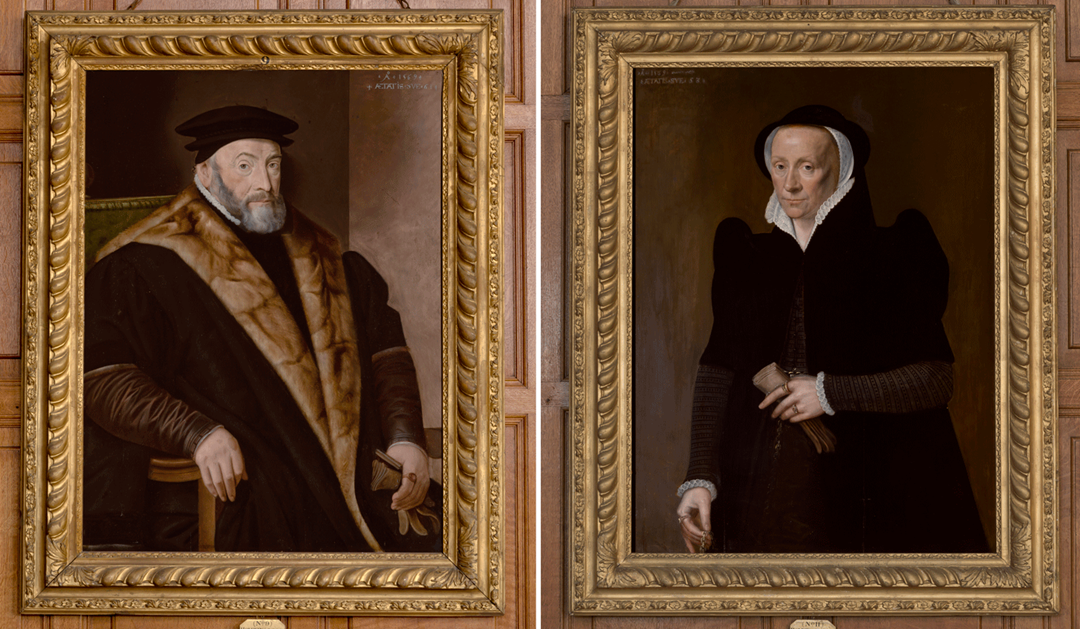
For the first time, portraits of Thomas Howard and his wife Katherine are being displayed at Audley End, the very house that they built. Alongside the Howards will hang portraits of Thomas’ mother Margaret Audley and his grandparents, Sir Thomas and Lady Elizabeth Audley. Together, these portraits trace the fortunes of one of Tudor and Jacobean England’s most powerful families and the changing face of British portraiture over the period.
Rising from the ashes of a derelict monastery, Audley End House was arguably the finest building in early modern England. Upon completion in 1614, it was the largest private house in the country. It was three times the size it is today, and described by contemporaries as superior to all the King’s houses.
The story of its creation is deeply entwined with the story of one of the most powerful families of the 16th and 17th century. Originally gifted by Henry VIII and extravagantly rebuilt using money embezzled from the coffers of James I and ultimately leading to the family’s disgrace. The new display tells the story of Audley End’s mighty dynasty and its changing fortunes over the course of a turbulent century, buffeted by shifting religious, political and artistic influences.
Thomas Audley rose from modest origins to become one of King Henry VIII’s most trusted ministers, and eventually Lord Chancellor.
In 1538, Henry rewarded Thomas with the recently dissolved Walden Abbey and he and his wife Elizabeth then set about transforming it into their principal residence, Audley End.
The displayed portraits of Thomas Audley and Elizabeth Grey were painted in 1569, after both sitters had died, in an Elizabethan act of commemoration. Technical examinations have shown that Elizabeth was originally depicted in a richly patterned gown, which was later painted over in black. Initially believed to be painted by Holbein, it is now thought the painter was trained in the Netherlands and working in England, within the circle of Adriaen Thomasz Key.
The most powerful nobleman in Elizabethan England takes ownership of Audley End through marriage, before a Catholic plot leads to execution for treason.
The only surviving child of Thomas and Elizabeth, Margaret Audley inherited Audley End upon her father’s death in 1544. Cousin of Lady Jane Grey, her second marriage was to Thomas Howard, the 4th Duke of Norfolk and most senior nobleman in England. Through this marriage, Audley End passed into the Duke’s estate.
The displayed portrait of Margaret was painted by leading Netherlandish artist Hans Eworh in 1562, just over a year before she died after childbirth at the age of 23. It was originally part of a pair, the other portrait being of her husband Thomas Howard.
Ten years after her death, Howard was executed for treason as a result of his role in the Ridolfi Plot, a plan to overthrow Elizabeth I with help from Spain, which involved Howard marrying Mary Queen of Scots and the couple taking the throne, thus returning England to Catholicism.
Rebuilt in the reign of James I as an opulent palace, Audley End leads to debt and corruption which became the family’s ultimate downfall
After his father’s execution in 1572, Thomas spent decades rebuilding Howard influence at court. He made an advantageous marriage to wealthy heiress Katherine Knyvett, who had strong political influence in her own right, and served his country in the Navy during the defeat of the Spanish Armada.
Upon James I’s succession in 1603, Thomas was created Earl of Suffolk and appointed Lord Chamberlain.
With their status transformed, Thomas and Katherine Howard built a vast new mansion at Audley End at extortionate cost and on a palatial scale.
In 1614, Thomas was made Lord Treasurer but his finances were crumbling, in large part due to the extravagance of their new home. To keep up with their debt, Thomas and Katherine stole money from the Treasury and accepted bribes, eventually being convicted of corruption and, narrowly avoiding execution, retiring to Audley End in disgrace. Their heirs were left with a tarnished name and a magnificent, but cripplingly expensive, estate.
On loan from Kenwood in London, Thomas and Katherine’s portraits signal their rank and authority. Painted by renowned artist William Larkin and his circle, known for highly polished jewel-like portraits, their images shine with wealth, power and influence.
From Monastery to Mansion: Portraiture, Power and Ambition opened on 28 March and runs until 1 November 2026. It can be viewed in Audley End’s Great Hall and entry is included with admission. Prices start from £22.10 per adult and £11.05 per child, with discounts available for families and concessions. English Heritage members go free.
For more information and how to visit Audley End:
www.english-heritage.org.uk/audley-end-house-and-gardens
Photographs: English Heritage 