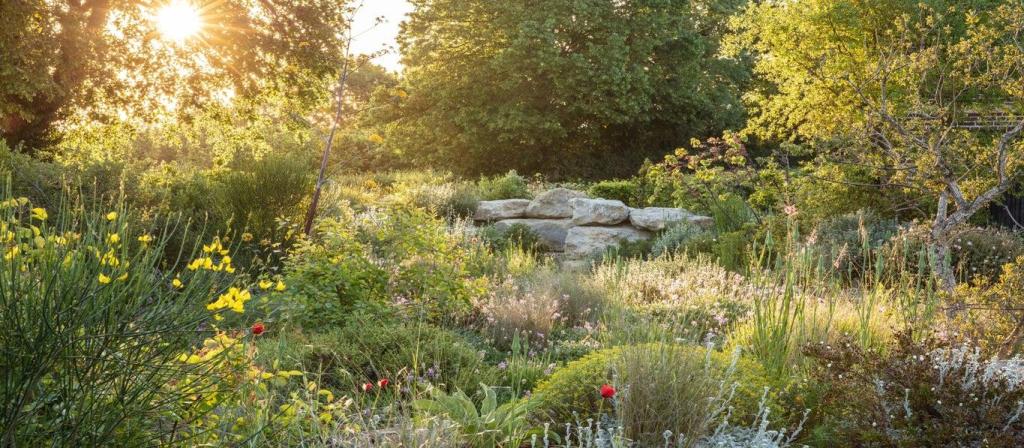

Greek inspired garden opens at Sissinghurst Castle in Kent
Work has finally been completed on ‘Delos’, the Greek-inspired garden at Sissinghurst Castle Garden in Kent. This completes a planting scheme that was first planned by Vita Sackville-West and her husband Harold Nicolson more than 90 years ago.
In 1935, Vita and Harold were so inspired by a visit to the Greek island of Delos that on their return they set about capturing its essence in a corner of their now world famous garden. However, they faced many challenges as amateur gardeners including the Kent climate and the north facing position of the garden. Despite their best efforts, the garden in their minds never quite materialised. Vita later commented on the Delos garden in 1953: “This has not been a success so far, but perhaps some day it will come right”.
Work first began to reimagine the Delos garden in 2018, when Sissinghurst’s Head Gardener Troy Scott Smith brought landscape designers Dan Pearson Studio on board. The heavy Wealden clay that originally scuppered Vita and Harold’s Mediterranean planting was released with a gritty topsoil, deliberately low in nutrients to better suit the planting scheme. The garden’s shady north facing aspect was overcome with the reduction of shade casting trees and raised terracing was built leaning south to capture the greatest available light.
Around 6,000 perennials typical of Greece and the wider Mediterranean were planted, along with pomegranate, cork oak and cypress trees, all naturally adapted to extreme conditions. That part of the garden was opened to the public in 2021.
Five years on, the garden has flourished, and Dan and his team were invited back to complete the second and final phase of the project.
In place of a 1980s garage adjoining the Priest’s House is a ravine with Mediterranean oak saplings leading visitors through the Little North Garden and into the White Garden for the first time. The new ravine extends the size of Delos by around 10 per cent. Under the newly planted oaks, dry and shade tolerant plants from the Mediterranean have been added. Shade was a challenge that was embraced in this final phase because it was something that Vita and Harold had problems overcoming. Through this greater variation of habitat, more specialised invertebrates have already been spotted including the green furrow bee, a bee that nests in rocks, and the privet hawk moth.
A Mediterranean palette of plants that come from Greece were used to in the new terraces in a style that evokes natural habitats.
Delos is a part of the conversation around using water more wisely and how gardening can be achieved in a changing climate. In the recent heatwave the plants in Delos have kept performing, while some other plants in the garden have shown signs of stress.
This extension of the Delos garden is now fully open to the public, bringing a vision to completion that has been nearly a century in the making.
To visit the gardens:
www.nationaltrust.org.uk/sissinghurst-castle-garden
Photograph: National Trust