

History of... Stoat
Name:
Stoat
Scientific Name:
Mustela erminea
Family:
Mustelidae
Conservation Status:
Leat Concern
Habitation:
Where there is suitable food, they occur in a wide range of habitats from lowland forests to upland moors and even towns.
Discovery:
Stoats have been around for about 5 to 7 million years.
Description:
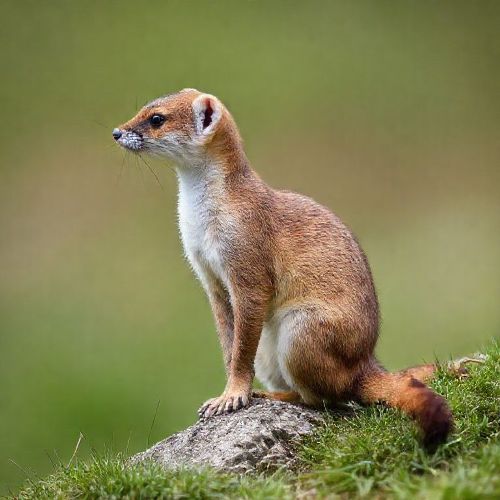
Stoats have a long, thin body with a tail that ends in a bushy black tip. Their fur is sandy-brown to chestnut with white-cream underbelly. They are around 30 to 40cm in length and weighing 200 to 400 grams.
An adult male is called a dog, hob or jack and a female is called a jill.
It's thought that the black tip to a stoat's tail serves to distract birds of prey by drawing the predator’s attention to attack the tail rather than the more vulnerable parts of the stoat’s body.
Behaviour and Social Structure:
Stoats moving in a series of quick, energetic leaps and bounds. They are also excellent climbers, and they climb trees to hunt, or escape predators. When hunting, they will perform a hypnotic dance to confuse prey as well as many other confusing antics.
Stoats are territorial with several dens within their territory. The nests of former prey are taken over as dens, which may be lined with rodent fur in colder climates.
Male and female stoats live separately, marking their territories with scent. They are known for defending their territory against intruders
Diet and Feeding Habits:
Rabbits are a stoat's favoured prey, even though they can be more than five times their size. They will also take voles, mice and rats, as well as birds and their eggs. Stoats can starve within 24 hours if they don’t find enough prey.
Breeding:
Stoats are solitary animals and only socialise with each other in the breeding season. Mating occurs in mid August.
A litter of around 6 to 12 young, known as kits, are born in spring. The female will care for the young until they are self sufficient at around 12 weeks.
After giving birth, a female stoat must eat half to three quarters of her body weight every day to produce enough milk for her kits. It gets even harder when the young kits are weaned because she must find enough food not only for herself but for the growing young.
Stoats have a Lifespan of 5 to 8 years, though many don't live beyond 1 or 2 years.
Threats to Population:
The species avoids spending long in the open, where it is vulnerable to attack from larger predators, such as foxes, domestic cats and birds of prey like owls and hawks.
Lack of food is probably the main cause of death for young stoats for which mortality is high.
In some places, stoats are considered a threat to native species, like ground nesting birds, which leads to trapping and removal by humans.