

History of... Adder
Name:
Adder
Scientific Name:
Vipera berus
Family:
Viperidae
Conservation Status:
Near threatened & Vulnerable
Habitation:
Woodland, heathland and moorland habitats.
Discovery:
Adders have existed in Britain for around 10,000 years.
Description:
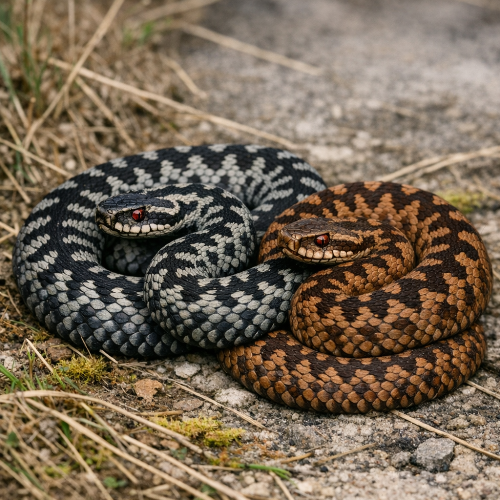
Males are silvery grey, white, or pale yellow with a high-contrast black zig-zag pattern. They are smaller than females and grow up to 60 cm. Females are brown, tan, or reddish with a dark brown zig-zag pattern and grow up to 75 to 80 cm.
Behaviour and Social Structure:
While normally living a solitary lifestyle, adders will gather socially during communal hibernation, post-emergence basking and mating.
Diet and Feeding Habits:
Adders are carnivorous predators that specialise in small vertebrates.
They are generalist feeders, meaning they consume a wide range of animals depending on what is available in their local habitat.
Adders do not eat often. An adult might only feed 6 to 10 times per year. A single small mammal can provide enough energy to last a month. They do not feed during hibernation. Females often fast for several months while pregnant.
Breeding:
Males emerge from hibernation in early spring, typically two to five weeks before females. Once the females emerge they leave scent trails from glands at the base of their tails. Males track these trails, sometimes travelling hundreds of metres a day to find a mate. If multiple males find the same female, they engage in a ritualised wrestling match. The males intertwine their bodies and rise off the ground while attempting to push the opponent's head down. This is a non violent test of strength and never bite each other during these duels. As reproduction is physically exhausting and females often fast during pregnancy, they typically only breed every two to three years.
Adders are ovoviviparous, meaning they incubate eggs internally. The young hatch inside the mother's body, appearing as a live birth. The pregnancy lasts for three to four months. The females give birth to a litter of 3 to 20 young. Each is born in a thin transparent sac from which it must immediately free itself. They are born fully formed with functional fangs and venom, ready to hunt small prey like worms or young lizards.
Despite legal protection under the Wildlife and Countryside Act 1981, populations are in significant decline, particularly in the UK. Experts suggest they could face near extinction by 2032 if current trends continue. Their decline is driven by a combination of habitat loss, environmental stress, and human related disturbance and killing due to fear.