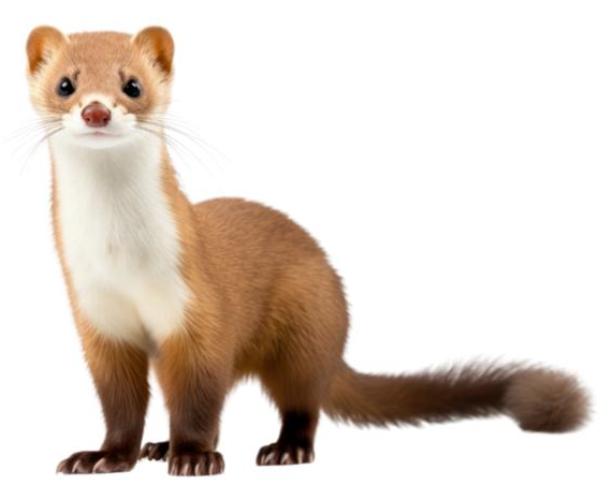


History of... Weasel
Name:
Weasel
Scientific Name:
Mustela
Family:
Mustelidae
Conservation Status:
Least concern
Habitation:
Areas with dense ground cover, such as woodlands, grasslands, hedgerows, farmland, and gardens.
Discovery:
Weasels appeared roughly 40 million years ago
Description:
A weasel is a small carnivorous mammal. They have extremely long, cylindrical bodies, long flexible necks, and very short legs. They are around 11 to 50 cm (4 to 20 inches) long, weigh about 250 to 350 g. Their fur is typically reddish brown on their back and head with a creamy white or yellow underside. In northern or high altitude regions, some species' fur turns completely white in winter for camouflage. Their tails are short and slim.
Behaviour and Social Structure:
Weasels are strictly solitary and territorial animals that only interact with other weasels to mate or raise young. Male territories are typically much larger, often 10 to 40 acres and may overlap with several female territories.
Diet and Feeding Habits:
They are obligate carnivores, meaning they rely almost entirely on meat, and their diet is heavily dictated by their small size.
Weasels are specialist hunters of small rodents, which make up 60% to 80% of their diet. Their prey includes voles, mice, Shrews. They also hunt much larger animals, such as rabbits and rats. If rodents are scarce they will eat small birds, eggs, frogs, insects or lizards.
Weasels lose heat rapidly and cannot store much body fat. To survive, they must eat one quarter to one third of their body weight every day.
Breeding:
Most weasels only live for 1 to 2 years in the wild.
Breeding typically occurs in spring and summer. They have a gestation period of about 34 to 37 days. They can sometimes produce two litters in a single year if food is abundant. A typical litter consists of 4 to 6 young (kits). The Kits are born blind and deaf, weighing only about 1 to 2 grams. At 3 weeks, they start eating meat.
At 5 weeks, their eyes open and they begin playing. At 8 weeks, they are proficient hunters and start to accompany their mother on hunts. At around 9 to 12 weeks old the mother forces her young out to find their own territories.
Threats to Population:
Many species are listed as least concern globally. Some populations are facing significant declines due to a combination of environmental, human, and natural factors.
Farming and urban expansion reduce the dense cover and hunting grounds weasels need to survive. Weasels often eat rodents that have eaten rat poison, which can lead to illness or death. They are sometimes trapped or killed by gamekeepers or farmers who view them as pests that threaten poultry and game birds. Despite their ferocity, weasels are preyed upon by many larger animals, including owls, hawks, eagles, foxes, badgers, minks, dogs and domestic cats.
Population Status:
Recent studies highlight worrying trends, such as a 50% decline in UK populations over the last 50 years.