

History of... Golden Eagle
Name:
Golden Eagle
Scientific Name:
Aquila chrysaetos
Family:
Accipitridae
Conservation Status:
Least Concern, although some regional populations are declining.
Habitation:
Golden eagles are found across the Northern Hemisphere, including North America, Europe, and parts of Asia and North Africa. They prefer open and semi-open landscapes such as mountains, cliffs, grasslands, and tundra. These environments provide ideal conditions for hunting and nesting, often on high cliffs or tall trees.
Discovery:
The golden eagle has been known to humans since ancient times and has been widely documented in early natural history writings. Its scientific classification was formally described by Carl Linnaeus in 1758 in his work Systema Naturae.
Description:
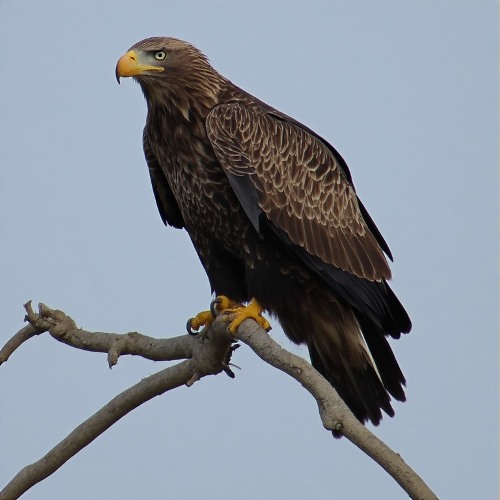
Golden eagles are one of the largest birds of prey in the world. They have a wingspan ranging from 1.8 to 2.3 meters (6 to 7.5 feet). Their plumage is dark brown, with distinctive yellow/golden feathers on the back of the head and neck, giving them their name. They have powerful talons and a strong, hooked beak designed for tearing flesh. Their eyesight is extremely sharp, allowing them to spot prey from great distances.
Behaviour and Social Structure:
Golden eagles are generally solitary or found in pairs, especially during the breeding season. They are territorial birds and can occupy large home ranges. Known for their impressive flight skills, they soar at great heights and use thermal currents to conserve energy. They are mostly active during the day.
Diet and Feeding Habits:
Golden eagles are carnivorous as their diet consists of meat. They eat mainly small to medium-sized mammals such as rabbits, hares, and ground squirrels. They may also hunt birds and occasionally reptiles. In some cases, they scavenge carrion. They use stealth, speed, and powerful dives to capture prey.
Breeding:
Golden eagles typically form long-term monogamous pairs. They build large nests called eyries on cliffs or in tall trees, often reusing and adding to them each year. The female usually lays 1 to 3 eggs, and incubation lasts about 40 to 45 days. Both parents are involved in raising the young, though usually only one chick survives due to competition.
Threats to Population:
Although globally stable, golden eagle populations face several threats in certain areas. These include habitat destruction, human disturbance, illegal hunting, and poisoning (often from bait intended for other predators). Collisions with wind turbines and power lines also pose risks. Conservation efforts focus on habitat protection and reducing human-wildlife conflict